MYBRAIN20 - MASTER / PHD APPLICATION

For those interested in pursuing a Master’s or PhD in the fields of fault location, protection schemes, or any other area of power systems, feel free to PM me personally. We can provide training in Matlab/ATPDraw. 🙂

The deadline to apply for MyBrain20 is August 21, 2024.


Call for Paper: 1st International Conference on Electrical, Robotics and Intelligent Systems 2024 (ELECRiS 2024)

Assalamualaikum and Greetings.. 


We are pleased to announce that the Faculty of Electrical Engineering & Technology, Universiti Malaysia Perlis (UniMAP), will be organising the 1st International Conference on Electrical, Robotics and Intelligent Systems 2024 (ELECRiS 2024).
 
Date: 2nd – 3th September 2024 (Monday - Tuesday)
Venue: Bertam Resort, Penang, Malaysia
Theme: "Empowering Tomorrow: Integrating Electrical, Robotics and Intelligent Systems for Sustainable Innovation"


Even Mode: Physical (In-person) & Online Conference

Conference Website: https://lnkd.in/gCDdHrFt
Conference Partner:
Global Trends in Engineering, Science & Technology (GTEST) 2024
KEYNOTE SPEAKER
Professor Dr. Hiroshi Takemura
Tokyo University of Science, Japan
Title: "Challenges in Developing Medical and Welfare Devices for Sustainnovation by Integrating Robotics and AI Technologies"
CONFERENCE TRACKS (but not limited to)
Track 1: Robotics, Mechatronics and Automation
Track 2: Intelligent Systems Methodologies and Applications
Track 3: Electrical Engineering and Automation
Track 4: Power Electronics, Energy Utilisation and Key Technologies
IMPORTANT DATES
Full Paper Submission (Final Extension): 15 July 2024
Notification of Acceptance: 15 May 2024 - 20 July 2024
Camera Ready, Registration & Payment: 31 July 2024
Conference Date: 2 - 3 September 2024

PUBLICATION
Authors can choose to publish in American Institute of Physics (AIP) conference proceedings or Scopus Indexed Journals.

PUBLICATION FEES

National:
Researcher (proceeding) - MYR 1000
Researcher (journal) - MYR 1700
Participant (delegate/listener) - MYR 350
International:

Researcher (proceeding) - USD 250
Researcher (journal) - USD 400
Participant (delegate/listener) - USD 100

ELECRiS 2024 Secretariat
Faculty of Electrical Engineering & Technology
Universiti Malaysia Perlis (UniMAP)
Pauh Putra Campus,
02600 Arau, Perlis

Workshop on Power System Simulations using Matlab Simulink

I have conducted a workshop for postgraduate students and lecturers on how to use Matlab and Simulink software to model and simulate power systems. I hope the knowledge shared will be beneficial to everyone.


INDUSTRIAL VISIT TO PERLIS POWER PLANT

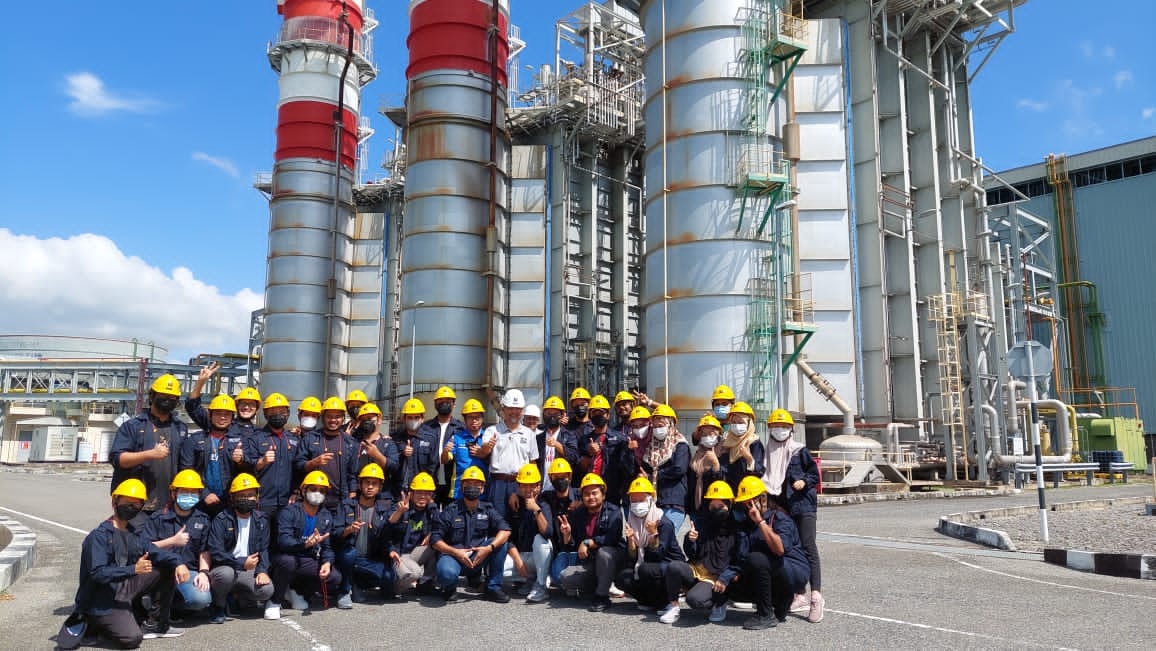
On December 20, 2023, I and my students studying Power System Protection & Switchgear visited the Perlis Power Plant for an industrial tour. The aim was to give students hands-on exposure to a crucial element of the power system—the power plant. Initially, we received a comprehensive briefing on the power plant's operations, covering organizational structures, company management, operational systems, and power generation control. This particular plant employs a combined cycle system, relying on natural gas as its primary fuel source for generating electricity. Within this setup, there exist two main turbines: the primary turbine, fueled by burning natural gas, and the secondary turbine, activated by steam derived from the primary turbine's combustion heat. Following the briefing, participants had the opportunity to witness various parts of the power plant installation, including the turbine room, step-up transformers, grid connections, water storage facilities, and the power generation control room (SCADA).


Restricted Earth Fault (REF) Relay

Restricted Earth Fault (REF) relay is used as a primary protection alongside differential relays for safeguarding transformers from ground faults in both the high-voltage (HV) and low-voltage (LV) windings.

Each HV and LV winding has its own REF relay. This relay isn't able to detect phase-to-phase faults or three-phase faults (without touching the ground) because its protection boundary is from the CT on one side (primary/HV) to the CT connected to the neutral on the primary/HV side of the primary/HV winding.

For the secondary/LV winding, the protection boundary is from the secondary/LV side CT to the CT connected to the secondary/LV neutral.

The REF relay can be used to protect both Y-Y and Y-Delta transformers. In the case of a Y-Delta transformer, the neutral earthing resistor (NER) is connected to the secondary/LV winding to provide a neutral connection for return current and transformer connection.

Figure 1 illustrates the operation of the REF relay. When a ground fault occurs in either the primary/HV or secondary/LV winding, no current flows through one of the CTs (input to the REF Relay), resulting in residual current entering the REF relay, exceeding the pickup current setting. The relay then sends a signal to the Master Trip relay, which subsequently sends a tripping signal to both breakers, the primary/HV, and the secondary/LV. There's no tripping delay as the REF relay acts as the primary protection for the transformer alongside the Differential relay.

Figure 1

Causes of Faults at Transmission Line

Transmission line faults can arise due to various reasons, and they can be categorized into several causes:

1. Weather Conditions - Adverse weather conditions like lightning, heavy storms, strong winds, ice, or snow can cause faults by physically damaging the transmission lines or creating conditions conducive to electrical faults.

2. Equipment FailureMalfunction or failure of components such as insulators, conductors, transformers, switches, etc can lead to faults along the transmission line.

Transformer insulation breakdown

3. Human Error - Mistakes made during maintenance, repair, or operational procedures can result in faults. Accidental contact with equipment or improper handling of the infrastructure can cause disruptions.

Crane encroachment [1]

The Difference between Transient & Permanent Faults

Transient Fault

  • Transient faults are those that disappear when power is interrupted and then restored.
  • Often caused by occurrences like lightning, momentary tree contact, or contact with animals.
  • In such cases, the line can be successfully re-closed after it's been tripped.
Source: A.A.Z. Zin, S.P.A. Karim, The application of fault signature analysis in Tenaga Nasional Berhad Malaysia

Permanent Fault

  • Permanent faults persist even when power is restored.
  • These faults stem from prolonged issues such as tree or crane encroachment, insulation breakdown, tower collapse, or cable damage.
  • Reclosing the line fails because the fault persists during the attempt to restore it.
Source: A.A.Z. Zin, S.P.A. Karim, The application of fault signature analysis in Tenaga Nasional Berhad Malaysia

Involved in STEM Program at Primary School Sekolah Kebangsaan Paya Kemunting, Jitra, Kedah.

Science, Technology, Engineering and Mathematic (STEM) program was conducted at SK Paya Kemunting (SKPK), Jitra, Kedah in collaboration with FKTE, FKTEN & IEEE UniMAP. Various exhibitions, games & STEM-based activities were held involving the participation of 290 level 2 students from SKPK. The program's objective is to cultivate students' interest in STEM. The Deputy Director of PPD Kubang Pasu also attended the program. Congratulations to the faculty, staffs involved and the management of SKPK. This program is a part of out university social responsibility (USR).


Joined Ekspo Rekacipta UniMAP (EREKA 2023)

I joined the EREKA (Ekspo Rekacipta UniMAP) competition, which was organized by the Centre for Innovation and Commercialization (CIC) UniMAP with the cooperation of the Office of Deputy Vise Chancellor for Research and Innovation, UniMAP. The competition was conducted from 10th to 12th March 2023. 

My innovation project title is "W-AIFaMS - Wireless Artificial Intelligence Based Fault Monitoring System".

My innovation project has been awarded with GOLD medal. 


Industrial Visit to HVDC Converter Station, Gurun, Kedah

HVDC Converter Station, Gurun, Kedah is a high-voltage direct current (HVDC) electrical power conversion station located in the Malaysian state of Kedah. It converts alternating current (AC) electricity generated by power plants into direct current (DC) electricity for long-distance transmission, and vice versa. HVDC technology is used to transmit large amounts of electrical power over long distances with minimal power loss.

This converter station is located in Gurun, Kedah and is connected to converter station at Khlong Ngae, Thailand through 300 kV DC transmission line. This HVDC grid connection increase the power system stability and security for the grid at North region of Peninsular Malaysia by connecting the grid of both countries. 


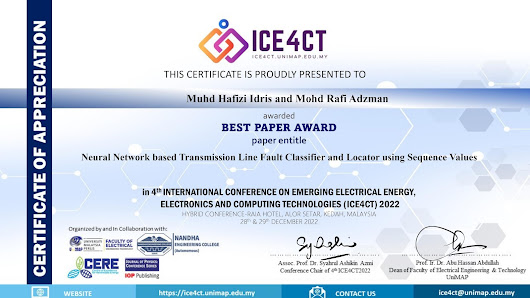
Best Paper Award at ICE4CT 2022

I have presented my research paper entitled "Neural Network based Transmission Line Fault Classifier and Locator using Sequence Values" at 4th International Conference on Emerging Electrical Energy, Electronics and Computing Technologies 2022. May paper has been selected as one of Best Paper for the conference. 


Successfully Organized the 3rd International Conference on Science, Engineering, and Technology (ICSET2023)

 Alhamdulillah..

We have successfully organized the 3rd International Conference on Science, Engineering, and Technology (ICSET2023) which was held at Raia Hotel, Kuala Terengganu, Terengganu, Malaysia from 22nd to 23rd June 2023. For this conference, I acted as the secretary. The accepted and presented papers will be submitted to AIP Conference Proceedings or Scopus indexed journals. The conference has been conducted in hybrid mode which combine the physical and online presentations. In this conference, I also presented a research paper.


Basic Components Of A Protection System

There are several basic components of a protection system as listed below:


CT (current transformer) 

  • Convert the primary current to secondary current and transmit the secondary current to protective relay.

VT (voltage transformer)

  • Convert the primary voltage to secondary voltage and transmit the secondary voltage to protective relay.

Protective relay 

  • Detect and locate the fault and send a trip signal to the circuit breaker.
  • When a fault occurred, the relay will operate by closing the relay contact to complete the trip circuit.

Battery / DC system

  • To supply the power for the relay and also to the trip circuit.

Trip coil

  • As the trip coil of the circuit breaker energized, the CB operating mechanism actuated and will make the CB to open and isolate the fault. 

Attended PECON 2018

Assalamualaikum.. 

I had presented a paper at IEEE International Conference on Power and Energy (PECON 2018) which was held at Kuala Lumpur from 3-4th December 2018.

My paper titled "Wide-Area Fault Location for Power Transmission Network using Reactance Based Method". Hopefully, I could send a paper for 2019 at the same conference.


Attended ICEESE 2018

Assalamualaikum.. 

I had presented a paper at 4th International Conference on Electrical, Electronics and System Engineering (ICEESE 2018) which was held at Kuala Lumpur from 8-9th November 2018.

My paper titled "Auto-Reclose Relay Simulation for Research & Education". Hopefully, I could send a paper for 2019.


Fault Resistance of the Fault Arc

Source: Jianping Wang, ABB, 2013-06-14 KTH

Arc which developed at the transmission line during fault occurrence can be due to an object very near to the line or due to lightning which make the fault current to jump to the transmission tower (earth). This arc representing an equivalent value of fault resistance, Rf. This Rf value is depends on the arc length and fault current. The longer the arc length, the higher the Rf while the higher the fault current the lower the fault resistance as shown by the equation in the figure above. 

The value of Rf can affects the accuracy of fault locating device and also the protection relay which uses the impedance based method (such as distance relay). For impedance based method relay, Rf can affects the accuracy of the relay in determining the tripping signal decision especially for fault near to the setting of zone reach. 

Charging Current Compensation of Differential Relay

For underground cables and long transmission lines, there will be significant effects of charging current on the accuracy of the protection relay. This charging current is the result of the distributed capacitance along the transmission line or underground cables as shown by figure below. The effects of the charging current for short transmission line is insignificant and can be neglected.


This charging current can introduces error in fault detection by installed protection relays. Some protection relays adapted with charging current compensation to eliminate the error in their algorithms.

One of the relay is line differential relay GRL100 by Toshiba. The charging current is also depending on value of the line voltage. So, the charging current is continuously calculated by the relay depending on the value of current line voltage and compensates it in the differential current calculation.

The procedure is the capacitance of the line be divided into two. Then, each terminal of the relay calculates the value of charging current at each terminal using the equation below.


Importants of Protective Apparatus in Power System Protection

Related Posts Plugin for WordPress, Blogger...