Featured post

🎓 Opportunity for Master’s & PhD Studies in Power System Protection ⚡

Are you passionate about advancing your expertise in power system protection, fault location, or related areas in electrical power engineeri...

Hands-On Training on AI-Based Power System Decision Using MATLAB and Simulink

On 12 June 2026, the Centre of Excellence for Renewable Energy (CERE), Universiti Malaysia Perlis (UniMAP), successfully organized a one-day Hands-On Training on AI-Based Power System Decision Using MATLAB and Simulink at the Power System Analysis Laboratory, FKTE. I had the privilege of serving as the trainer for this program, which attracted participants interested in artificial intelligence applications in power systems.

The training was designed to provide participants with both theoretical knowledge and practical experience in integrating Artificial Intelligence (AI) techniques into power system analysis and decision-making. Throughout the session, participants were introduced to the fundamentals of machine learning and neural networks, followed by hands-on exercises using MATLAB and Simulink.

The workshop covered several important topics, including power system modeling and simulation, fault analysis, system performance evaluation, neural network development, and AI-assisted decision-making. Participants were guided step-by-step in developing AI models and applying them to solve engineering problems related to power systems.

One of the key objectives of the training was to bridge the gap between conventional power system analysis and emerging AI technologies. As power systems become increasingly complex with the integration of renewable energy resources, advanced data-driven approaches are becoming essential for improving system reliability, efficiency, and operational decision-making.

The interactive nature of the workshop enabled participants to gain valuable practical experience through simulation exercises, discussions, and problem-solving activities. 

I would like to express my sincere appreciation to CERE, FKTE, and UniMAP for their continuous support. Special thanks are also extended to all participants for their commitment and engagement throughout the day.

It is my hope that the knowledge and skills gained from this workshop will assist participants in their future research, academic activities, and professional careers, particularly in the rapidly evolving fields of Artificial Intelligence, Renewable Energy, and Smart Power Systems.


🎓 Opportunity for Master’s & PhD Studies in Power System Protection ⚡

Are you passionate about advancing your expertise in power system protection, fault location, or related areas in electrical power engineering?


I am currently welcoming prospective Master’s and PhD candidates, especially working professionals from the industry, who are interested in pursuing postgraduate studies and engaging in impactful research.

💡 If you are currently facing real industrial problems related to these areas, you are highly encouraged to bring them forward. These challenges can be expanded and developed into meaningful Master’s or PhD research topics, ensuring your study is practical, relevant, and industry-driven.

This is a great opportunity to:

✔️ Deepen your technical knowledge in protection systems
✔️ Work on real-world, industry-based problems
✔️ Collaborate on innovative solutions for modern power systems

🛠️ Available expertise & tools:

• MATLAB/Simulink
• ATPDraw (EMTP)
• Arduino-based prototyping
• ETAP for power system studies

If you are interested or would like to discuss potential research topics, feel free to reach out:

📧 Email: hafiziidris@unimap.edu.my
📱 Phone: +60134885657

Let’s connect and explore how we can work together towards advancing the future of power systems.

Some of my past researchs/publications:

1. Enhanced Standalone Distance Relay by Removing DC Component and Eliminating Fault Resistance Effect
2. Effect of Load Variation and Fault Resistance on the Operation Time of IDMT Overcurrent Relay
3. Neural Network based Transmission Line Fault Classifier and Locator using Sequence Values
4. Differential equation fault location algorithm with harmonic effects in power system
5. Enhanced two-terminal impedance-based fault location using sequence values
6. Wireless IoT based Overcurrent Relay for Transmission Line Protection
7. Two-terminal fault detection and location for hybrid transmission circuit
8. Auto-Reclose Relay Simulation for Education & Research
9. Arcing fault diagnosis using first peak arrival of EM radiation signal
10. Fault Localization and Detection in Medium Voltage Distribution Network Using Adaptive Neuro-Fuzzy Inference System (ANFIS)
11. Effect of Distributed Generation to the Faults in Medium Voltage Network Using ATP-EMTP Simulation
12. Evaluation of Denoising Performance for Noisy Arc Fault Signal Based on Mother Wavelet Selection
13. Combination effects of fault resistance and remote in feed current on simple impedance based fault location
14. Wide Area Fault Location for Power Transmission Network using Reactance Based Method
15. Effective Two-Terminal Single Line to Ground Fault Location Algorithm
16. The Effects of Different Load Power Factors on the Performance of Distance Relay
17. The Effect of Harmonic Distortion on the Performance of Differential Relay for Distribution Transformer Protection
18. Adaptive Mho Type Distance Relaying Scheme with Fault Resistance Compensation


APPLICATION FOR MYBRAIN 2.0 IS NOW OPENED - APPLY FOR PHD/MASTER STUDY

 ðŸ“Œ What is MyBrain 2.0?

MyBrain 2.0 is a scholarship / education sponsorship program offered by the Ministry of Higher Education Malaysia (MOHE) to support Malaysians in pursuing postgraduate studies at the Master’s and Doctor of Philosophy (PhD) levels in local Higher Education Institutions. It is a continuation of the earlier MyBrain15 program.


📌 Who is eligible to apply?

The program is open to:

✔ Malaysian citizens who are unemployed or do not have a fixed income, and
✔ Selected private university lecturers.


📌 Priority Fields of Study

Priority is given to fields such as:

• STEM (Science, Technology, Engineering & Mathematics)
• Selected Social Sciences and Professional Arts disciplines


📌 Scholarship / Sponsorship Benefits

✔ Tuition fees are covered up to a specified maximum rate (RM2,300 per semester for Master’s, RM3,750 per semester for PhD).
✔ The scholarship provides a living allowance throughout the study period (amount and terms vary according to status and current guidelines).
✔ The main objective of this sponsorship is to cultivate highly capable research talent and enhance graduates’ career development.


📌 Program Objectives

✔ To develop high-caliber research talent.
✔ To support career advancement, graduate employability, and improved quality of life.
✔ To increase high-impact research outcomes for society, communities, and the nation.


📌 How & When to Apply

👉 Applications are submitted online through the official MyBrain 2.0 system (as stated in the poster).
👉 The application window opens during specific periods each session (please refer to the official announcement for the current year).
👉 Don’t miss this opportunity — applications open only once a year.
👉 Prepare your university offer letter, research proposal, and academic documents to strengthen your chances of being awarded the sponsorship.


📩 If you are interested in pursuing a PhD or Master’s in Power Systems or Power System Protection & Fault Location, feel free to PM me for further discussion.

Please visit the link below for more information and detailed requirements:

https://biasiswa.mohe.gov.my/MyBrain2/?fbclid=IwY2xjawPwSPhleHRuA2FlbQIxMABicmlkETFKUDVwVTJJNVRSZVJwS0Jxc3J0YwZhcHBfaWQQMjIyMDM5MTc4ODIwMDg5MgABHsWYxniOftju3WdNCiwwAf5VWOXFX6F1NL73iaWwNZ53B8btQmqXKPvaJbp9_aem_4uCbCwwQznu840Plxb68hQ

MYBRAIN20 - MASTER / PHD APPLICATION

For those interested in pursuing a Master’s or PhD in the fields of fault location, protection schemes, or any other area of power systems, feel free to PM me personally. We can provide training in Matlab/ATPDraw. 🙂

The deadline to apply for MyBrain20 is August 21, 2024.


Call for Paper: 1st International Conference on Electrical, Robotics and Intelligent Systems 2024 (ELECRiS 2024)

Assalamualaikum and Greetings.. 


We are pleased to announce that the Faculty of Electrical Engineering & Technology, Universiti Malaysia Perlis (UniMAP), will be organising the 1st International Conference on Electrical, Robotics and Intelligent Systems 2024 (ELECRiS 2024).
 
Date: 2nd – 3th September 2024 (Monday - Tuesday)
Venue: Bertam Resort, Penang, Malaysia
Theme: "Empowering Tomorrow: Integrating Electrical, Robotics and Intelligent Systems for Sustainable Innovation"


Even Mode: Physical (In-person) & Online Conference

Conference Website: https://lnkd.in/gCDdHrFt
Conference Partner:
Global Trends in Engineering, Science & Technology (GTEST) 2024
KEYNOTE SPEAKER
Professor Dr. Hiroshi Takemura
Tokyo University of Science, Japan
Title: "Challenges in Developing Medical and Welfare Devices for Sustainnovation by Integrating Robotics and AI Technologies"
CONFERENCE TRACKS (but not limited to)
Track 1: Robotics, Mechatronics and Automation
Track 2: Intelligent Systems Methodologies and Applications
Track 3: Electrical Engineering and Automation
Track 4: Power Electronics, Energy Utilisation and Key Technologies
IMPORTANT DATES
Full Paper Submission (Final Extension): 15 July 2024
Notification of Acceptance: 15 May 2024 - 20 July 2024
Camera Ready, Registration & Payment: 31 July 2024
Conference Date: 2 - 3 September 2024

PUBLICATION
Authors can choose to publish in American Institute of Physics (AIP) conference proceedings or Scopus Indexed Journals.

PUBLICATION FEES

National:
Researcher (proceeding) - MYR 1000
Researcher (journal) - MYR 1700
Participant (delegate/listener) - MYR 350
International:

Researcher (proceeding) - USD 250
Researcher (journal) - USD 400
Participant (delegate/listener) - USD 100

ELECRiS 2024 Secretariat
Faculty of Electrical Engineering & Technology
Universiti Malaysia Perlis (UniMAP)
Pauh Putra Campus,
02600 Arau, Perlis

Workshop on Power System Simulations using Matlab Simulink

I have conducted a workshop for postgraduate students and lecturers on how to use Matlab and Simulink software to model and simulate power systems. I hope the knowledge shared will be beneficial to everyone.


INDUSTRIAL VISIT TO PERLIS POWER PLANT

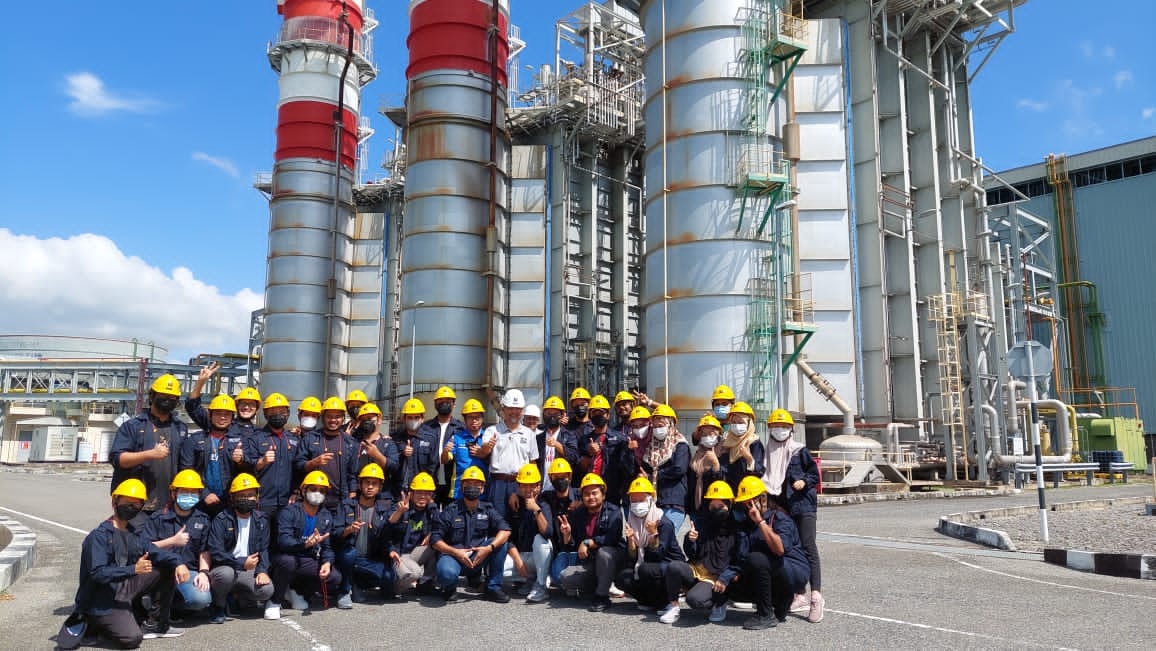
On December 20, 2023, I and my students studying Power System Protection & Switchgear visited the Perlis Power Plant for an industrial tour. The aim was to give students hands-on exposure to a crucial element of the power system—the power plant. Initially, we received a comprehensive briefing on the power plant's operations, covering organizational structures, company management, operational systems, and power generation control. This particular plant employs a combined cycle system, relying on natural gas as its primary fuel source for generating electricity. Within this setup, there exist two main turbines: the primary turbine, fueled by burning natural gas, and the secondary turbine, activated by steam derived from the primary turbine's combustion heat. Following the briefing, participants had the opportunity to witness various parts of the power plant installation, including the turbine room, step-up transformers, grid connections, water storage facilities, and the power generation control room (SCADA).


Related Posts Plugin for WordPress, Blogger...